
What Is Slop?
A short exploration of how AI is changing the signals of value in work and culture.

“You must either make a tool of the creature, or a man of him. You cannot make both.” - John Ruskin, "The Nature of Gothic" (1853)
This week alone three of the internet's biggest platforms declared war on AI slop. Snapchat launched a campaign called "Stop the Slop." LinkedIn announced it had blocked billions of low-quality AI-generated posts and is rolling out tools for users to flag “AI Slop”. Substack's CEO warned that nearly 40% of writing circulating on social media may already be AI-made, and that it's getting harder to tell what's real.
Everyone agrees slop is a problem. But almost nobody agrees on what it actually is, it’s more of a feeling … or maybe a vibe that’s hard to define. But most people say they know it when they see it.
On social media, slop has come to mean almost anything that sounds AI-generated. After Hank Green admitted using ChatGPT while researching a video, his audience began treating his sentences like forensic evidence. One phrase “I appreciate the pushback” was enough for some to conclude the entire script had been written by AI, despite his insistence that the line was his own.
Inside startups, the concern is different. A founder recently showed me what his two-person marketing team had produced in a single day: positioning frameworks, landing pages, ad concepts, design mockups, even the SQL behind the funnel. By any traditional measure, insane output. His reaction? "Everything feels generic. The messaging, the campaigns … like it came straight from Claude."
Platforms worry about trust. Creators worry about disclosure. Founders worry about work that is technically correct but strangely empty. Yet almost everyone involved already uses AI in some part of their workflow. More than a quarter of employed Americans now report using AI for work every week, making it one of the fastest-adopted workplace technologies in history.
We stopped debating whether to use AI a while ago. What we haven’t settled is what makes work valuable in a world where AI has become ordinary.
Where Slop comes from
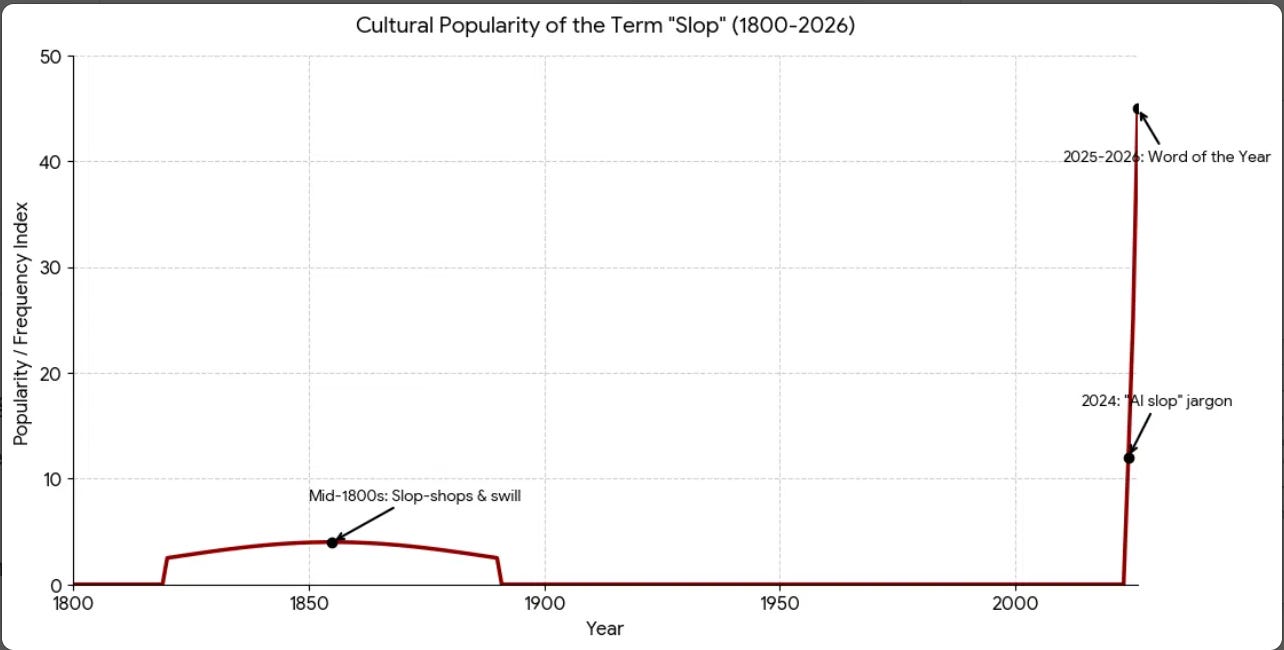
The word is old, and for most of its life it was boring. It traces to around 1400, meaning “mudhole, puddle,” from an Old English root for dung. Then it spikes, and the timing matters. Look at when “slop” enters common use and it’s the Industrial Revolution.
“Slop shops” appeared across London, Liverpool, and Manchester, selling ready-made clothing produced fast and sold cheap to a rapidly expanding urban workforce. The word shifted from a specific kind of sailor’s garment to a general description of goods made without the attention of a tailor.
The Victorian journalist Henry Mayhew walked those streets in the 1850s, interviewing tailors, dockworkers, and factory laborers, recording what industrialization felt like from the inside. What came from those conversations went beyond the familiar story that industrialization made production cheaper, faster, and more abundant. More fundamentally, it made production itself a less reliable signal of craftsmanship.
I think this definition is surprisingly relevant to the debate we’re having today. In this sense, slop is what we call work when the relationship between the output and the process that produced it becomes impossible to see. That probably explains why people reach for words like “lazy,” “spammy,” “low quality,” “anti-taste,” or, more poetically, “soulless.”
Blaming AI simply because it makes production easier tells only half the story. That’s what transformative technologies have always done in the past: they lower the cost of production, and in doing so they break the signals we used to judge value.
Think about it: we’ve spent decades treating the final product as evidence of skill because it was the best signal available. If someone wrote a book, designed a logo, developed software, or drafted a strategy, we could reasonably say that significant time, knowledge, and expertise had gone into it. Producing something was expensive, and that cost carried information. The output signaled the capability behind it.
One side of that equation, especially among some AI enthusiasts, is that because production got cheap, expertise stopped mattering. I personally think that’s wrong, and the correction is narrow but important: AI didn’t eliminate expertise. It eliminated production as a reliable signal of expertise.
The change is epistemic, not economic. Whether we’re evaluating writing, research, design, or software, the existence of an output no longer tells us what it used to.
Which puts AI inside a much longer story. Photography didn’t kill painting; it freed painting from being judged on its ability to reproduce reality. The internet didn’t kill expertise; it made information abundant and shifted the value to synthesis. Seen from this angle, AI is changing the evidence by which we recognize those qualities.
The Alien Painting Experiment
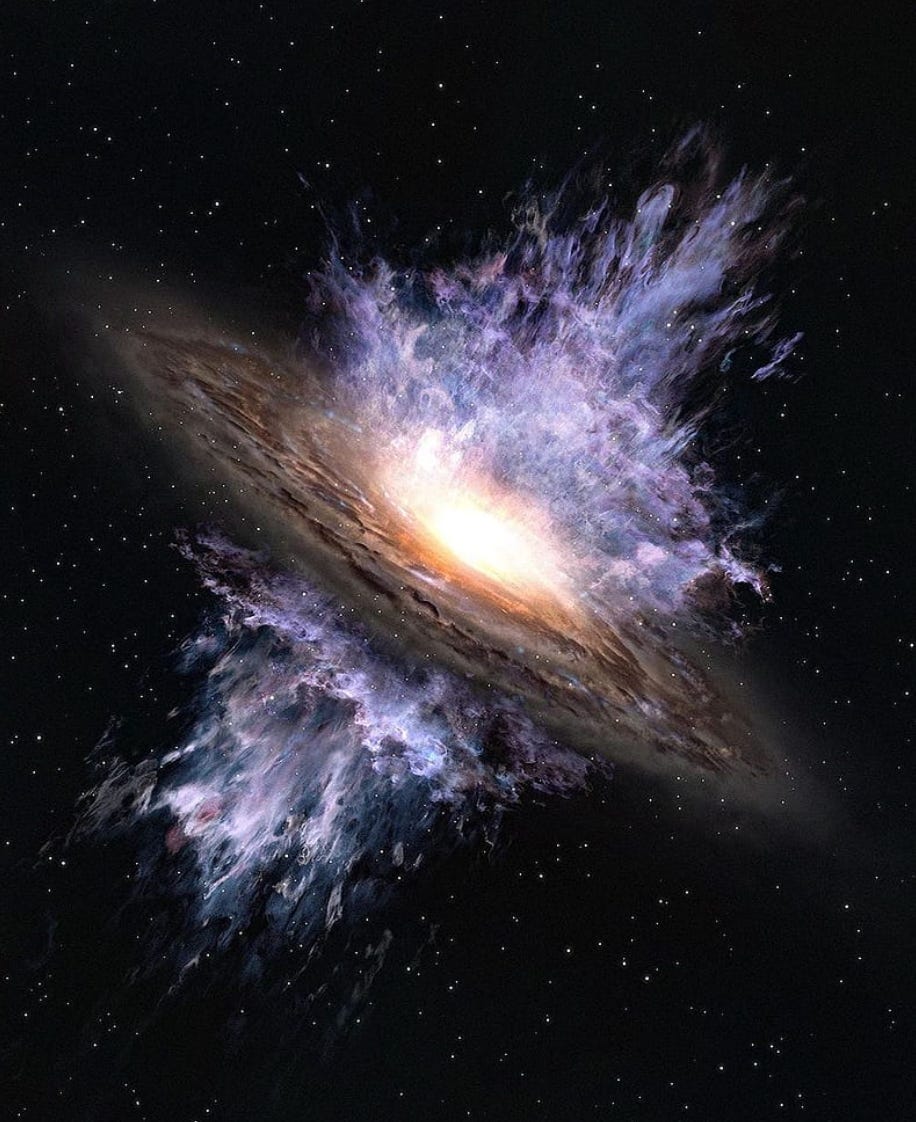
Here’s a thought experiment I want to run by you. Imagine an alien civilization arrives on Earth carrying a painting. They explain:
After traveling across the universe for millions of years, we wanted to show your species what the destruction of our home galaxy felt like. One member of our civilization painted this after watching our home world disappear in a stellar collapse.
We don’t understand their symbols. We don’t understand their colors or composition. But somehow I suspect many of us would still find the painting deeply moving.
Now let’s change only one thing. Same painting:
After traveling across the universe for millions of years, we wanted to show your species what the destruction of our home galaxy felt like. Our generative intelligence system produced ten billion paintings and, after evaluating millions of possible compositions, colors, and forms, selected this as the image most likely to resonate with your species.
Nothing about the object has changed. But for most people, something important has. The usual explanation is that one was made by something alive.
I'm not convinced that's the distinction. So the aliens try once more:
This painting was created by one of our artificial intelligences. For the last five hundred years it has wandered our galaxy. It has watched civilizations emerge and disappear. It has made predictions that failed, revised its beliefs, formed relationships unlike its own, mourned companions it outlived, and been changed by what it experienced. This painting is its attempt to communicate what all of that felt like.
If your reaction changes in the third scenario, then humanity was never the criterion. There’s a nuance to this thought experiment and worth stating precisely: the first story is trying to communicate what it felt like. The second is trying to maximize what we’ll feel. And the third? The third is a little strange. Somehow, it didn’t feel manipulative. It was trying to communicate what it discovered, what it witness through the passage of time.
What we’re responding to is the belief that something behind the work had genuinely encountered the world and had been transformed by it.
Evidence of transformation.
We recognize this everywhere. The scientist whose hypotheses failed until one didn’t. The founder who rebuilt her strategy after customers proved her wrong. The artist who spent years failing to define her style until she finally found it. In these examples, do we really value the number of hours people spent on their task? Or is it the work itself? I think it’s something in between: the sense that the work embodies a genuine process of discovery, struggle, revision, and growth.
But notice what just happened
It would be easy to walk away from this experiment thinking that transformation is the new measure of value. I don’t think that’s right either. Exactly what counts as evidence of transformation is a much harder question.
It’s easy to imagine someone writing a LinkedIn post tomorrow that says:
“I could have asked AI to write this, but instead I drew on my lived experience…”
That, too, can be slop. Not because it mentions lived experience, but because it performs transformation rather than demonstrating it. It’s wearing the uniform without doing the work.
So let me be clear.
None of this is to say that work made with AI is inherently shallow, or that work made by humans is inherently meaningful. History gives us plenty of evidence to the contrary. Humans have been producing slop for centuries.
At the same time, I’ve watched AI unlock extraordinary curiosity, creativity, and craftsmanship in people who previously lacked the time, confidence, resources, or technical skills to express what they knew. I’ve also watched it accelerate the production of work that is technically competent, but extremely flat and disconnected from reality.
The technology amplifies both. What determines the outcome is whether the work bears evidence that something meaningful happened before it existed. That evidence might be the trace of a mind encountering reality: testing ideas, revising beliefs, developing judgment, discovering something unexpected. Sometimes AI isn’t separate from that transformation, it becomes one of the ways it happens.
So rather than concluding everything touched by AI as slop, maybe we can ask ourselves: can people using this technology still be transformed by it? Can their work still carry the marks of experience, judgment, and genuine care?
And, more importantly, what kind of work reveals the richness of life rather than simply optimizing for a response? I believe the answer is yes. I’ve seen enough evidence to believe we’re only beginning to understand what that looks like.
- Life is richer than the model -
About the author: Gil Almeida writes about intelligence, technology, and what it means to remain fully human in the age of artificial intelligence.
After leading marketing and product strategy at companies including Airbnb, Uber, Spotify, and AI startups, she became increasingly interested in a different set of questions: how people learn, how organizations think, how technology changes the way we create value, and how AI is reshaping our understanding of intelligence itself.
Her essays sit at the intersection of philosophy, psychology, economics and technology, exploring the deeper ideas hidden beneath moments of technological change.