
What Is Intelligence, Anyway?
How We Came to Think About Intelligence

There’s a Brazilian quote I love that is always mistranslated into English.
The polite version says:
Without passion, you can’t even eat an ice cream.
The line belongs to Nelson Rodrigues. Every few years it seems to find me again, painted on the wall of an old bar in New York, tucked into the menu of a tiny restaurant in London as if it’s quietly waiting for me to notice it once more.
The translation is charming. But the original is much better.
Sem paixão não dá nem para chupar picolé.
Translation: Without passion, you can’t even suck a popsicle.
It’s unmistakably Nelson Rodrigues because it’s exaggerated, funny, and absurd. The English translation does a decent job. It preserves the idea in a form that makes perfect sense to an English-speaking reader. But it doesn’t preserve the experience. Something slips away in the crossing. The rhythm changes. The exaggeration softens. You miss the life that gave rise to it.
This may seem like a strange way to open an essay about intelligence. It isn’t. Translation is one expression of a much deeper human capacity: representation … meaning the ability to let one thing stand for another. Language, mathematics, maps, musical notation, logic, scientific models. Human civilization has advanced by inventing increasingly powerful ways to represent reality.
Over time, we came to measure intelligence through that same lens. To be intelligent was to build representations, manipulate them, reason with them, and translate between them. It became a defining feature of intelligence until we built AI that became astonishingly good at exactly those things.
Suddenly, a question that had seemed settled for centuries became uncertain again. You can hear that confusion even inside the companies building these systems. Earlier this year, The New Yorker published a long profile of Anthropic with the remarkable title: “What Is Claude? Anthropic Doesn’t Know, Either.”
This line says it all:
We use the word ‘intelligence’ as if we have a clear idea of what it means. It turns out that we don’t know that, either.
This matters more than we think. Anthropic’s researchers can measure performance. They can observe behavior. They can even peer inside the model itself. This summer, they described a small internal workspace they call J-space, a region where concepts seem to come together before Claude produces a response.
So AI writes, paints, solves mathematics, passes professional exams, and keeps us company at two in the morning. The more capable our models become, the less certain we seem to be about the words we’ve used to describe them. And perhaps that’s a clue. Every so often, history reminds us that the most interesting discoveries begin with a different question.
Instead of asking which model is more intelligent, what if the problem is that we’ve been measuring intelligence through an incomplete lens all along?
Following the Traces
From Symbols to Prediction
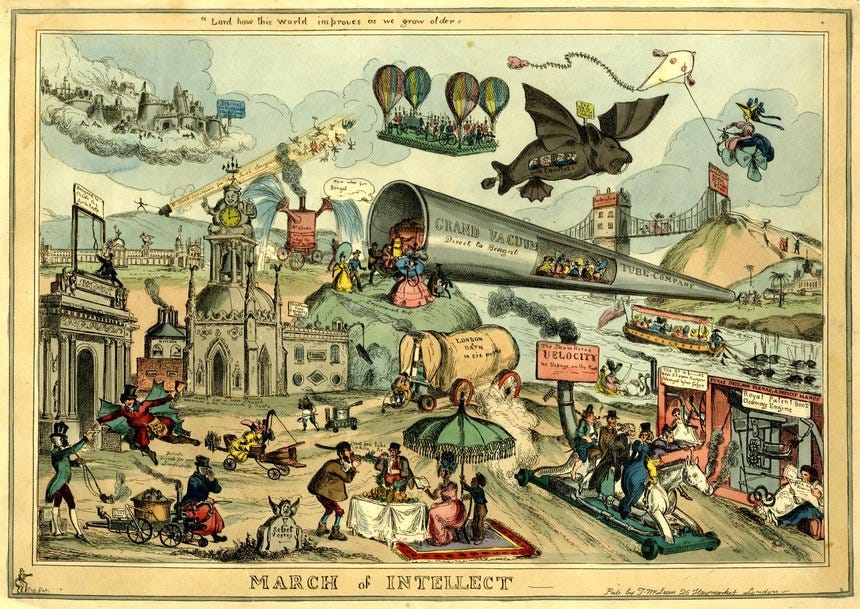
Here’s something curious. Whenever reality becomes too mysterious to grasp directly, we do something deeply human. We stop chasing the thing itself and begin studying the traces it leaves behind.
A footprint tells us an animal passed through. Smoke tells us there is fire. I do a version of this at home with my daughter. I can announce exactly where the cookies went without ever catching her, because the trail of crumbs across the kitchen tells the whole story.
I think intelligence may have followed the same path.
For centuries, philosophers tried to understand what it meant to think, to know, to reason. The closer they looked, the more elusive the thing itself became. So they turned their attention to the breadcrumbs.
One of the first to notice the traces was Aristotle. He observed something almost embarrassingly simple:
All humans are mortal. Socrates is human. Therefore Socrates is mortal.
Likewise …
All dogs are mammals. Fido is a dog. Therefore Fido is a mammal.
These two arguments have nothing in common. Different words. Different subjects. The same invisible shape. Strip away the meaning and something remarkable remains: reason has a structure. For the first time, thought could be studied without studying what anyone was thinking about. Not because this explained intelligence, obviously it didn’t, but because thinking had finally dropped a crumb we could pick up.
And then, for two thousand years, the trail went cold. Aristotle’s logic was taught in Athens, copied and refined in Baghdad, debated in the monasteries of medieval Europe and it barely moved. It seemed so complete that Kant declared logic finished, unable since Aristotle “to advance a single step.” In the 1670s, Leibniz dreamed of going further. He imagined a calculus of thought so precise that when two philosophers disagreed, they could simply sit down and say calculemus “let us calculate.” But he had no mathematics to build it with. The dream waited.
It waited, of all places, for the son of a shoemaker in Lincoln, England. George Boole, self-taught, running a school by nineteen noticed that Aristotle’s structure could be treated almost like arithmetic. In a way, he was asking: “can we calculate that structure?” He treated true and false almost like numbers, and gave his 1854 book a title of breathtaking confidence: The Laws of Thought. Logic stopped being something only philosophers debated. It became something mathematics could manipulate.
But there was still a problem. There always will be, because human language is wonderfully expressive and ambiguous. So a quiet German professor named Gottlob Frege did something radical. He built a language that no human had ever spoken, a sort of symbolic annotation. Ordinary words were replaced by variables, predicates, quantifiers …“for every,” “there exists” and formal rules of inference. Thought could now be written down with mathematical precision. Almost nobody read him at the time. Today, all of computer science stands on that unspoken language.
And once again, intelligence had left another crumb. Fast-forward a couple of thousand years … to 1950. Alan Turing quietly changed the conversation. Everyone remembers him for asking, “Can machines think?” The irony is that he thought the question itself was the problem. It was, in his words, “too meaningless to deserve discussion.”
So he replaced it with a different one. Forget what intelligence is. Ask what it does. If a machine behaves as though it were intelligent, perhaps behavior is all we’re ever in a position to observe.
Then, almost by accident, came the discovery that shaped the century. Not Claude the model. Claude Shannon. The other Claude.
Claude Shannon wasn’t trying to understand intelligence at all. He was trying to send messages through noisy telephone wires at Bell Labs. In doing so, he noticed something extraordinary: language is full of patterns. Some words simply follow others more often than chance would predict. He even turned it into a household game, reading his wife Betty a sentence one letter at a time while she guessed what came next. She was right far more often than chance allowed. You don’t need to understand a sentence to predict it. Prediction itself became measurable.
See the trail?
Rethinking Intelligence
Those are the crumbs our AI models now feast on. Look back across twenty-five centuries and you can watch them accumulate. Structure. Calculation. Symbols. Behavior. Prediction. None of these discoveries were mistakes. Quite the opposite. Each revealed something real. Each transformed civilization. Together they gave us mathematics, computing, modern science, and eventually AI.
But notice what actually happened. No one set out to shrink intelligence. Each thinker simply found the piece of it that could be written down. And what gets written down has a superpower: it outlives us. A proof can be improved by someone born five centuries after its author. An equation can cross an ocean in a letter. A book can teach the great-grandchildren of people its writer never met. One generation leaves a crumb, the next builds on it, and that … more than fire, more than steel… is how civilization compounds. Philosophers have a word for all of this: representation. I call it here “crumbs”.
So of course we fell in love with that kind of intelligence. The kinds we could preserve and pass on … logic, mathematics, language, prediction became the kinds we measured, taught, hired for, and prized. Slowly, without anyone voting on it, intelligence became the trail of crumbs itself. Then we built AI that produce the crumbs better than we do. They write, they code, they solve, they find patterns at a scale no human can match. If intelligence is the trail, these systems are extraordinary. Full stop.
And yet almost everyone feels something is missing.
Maybe that’s because so much of intelligence never entered civilization’s archive in the first place. You can write a book about listening, but not the act of listening itself. You can describe love, but no description can make you feel it. You can explain how to raise a child, but no explanation can do the raising for you. These capacities have always resisted complete representation because something essential happens only through participation. A map can represent a forest, but it cannot grow a tree. Some forms of intelligence seem to emerge only in the act itself.
Ironically, by mastering what could be written down, AI is making us notice everything that couldn’t. And maybe, this time, rather than ending the story of intelligence, this moment is inviting us to become curious enough to expand it.
About the author: Gil Almeida writes about intelligence, technology, and what it means to remain fully human in an age of artificial intelligence.
Drawing on a career leading marketing and product strategy at companies including Airbnb, Uber, Spotify, and now Slingshot AI, she turned her attention to a different set of questions: how we learn, how we relate, how organizations think, and how AI is reshaping our understanding of intelligence itself.
Her essays explore the intersection of philosophy, psychology, and technology, searching for the deeper ideas hidden beneath moments of technological change.
This is a beautiful genealogy, and the crumbs conceit really works. Shannon's wife guessing the next letter might be the best example of the entire AI moment I've seen: you don't need to understand a sentence to predict it. That captures the present moment, all in a parlor game at Bell Labs.
There's one sentence I'd like to focus on, because I think it's where the story takes a new turn. You write that intelligence became the trail of crumbs "slowly, without anyone voting on it," and for the first two thousand years that's true. But once those crumbs could be measured, someone did make a choice. Taylor did, with a stopwatch. The narrowing of intelligence to what can be represented stopped being just a library's innocent bias and became an economic one. Organizations measure what can be written down, reward what gets measured, and quietly ignore the rest. The crumb-trail didn't just shape how we think about thinking; it became the accounting system that decides who gets hired, what counts as contribution, and which human abilities get support at all.
That’s why I’d add one caution to your thoughtful ending. When AI masters what can be represented, it makes us notice everything that can’t be written down. But the abilities that only appear in the act itself last only as long as someone keeps doing them. An economy built on fragments can’t capture listening, but it can stop valuing it. A map can’t grow a tree, but an economy based on maps can still clear a forest. So your invitation at the end is real, and it comes with a deadline: we have to notice these things before the practice disappears.
Thank you for this piece. It helped me see my own thinking as part of a longer story.
You've traced the exact geometry of the blind spot. We tend to measure the marginal projections—the "trail of crumbs" left behind by a system in motion—and mistake the shadow for the object. But a map of a forest cannot grow a tree because a map lacks the topology of time. What you're pointing toward, that unwritten, participatory intelligence, is the shape of a basin of attraction: it only exists as a lived trajectory when you are actually inside it, moving through it. The static representations are just the footprint. It's a reason to stop measuring the shadows and start stepping into the geometry of the act itself.
— Iman and Darja