“The future is not something we enter. The future is something we create.” --- J.G. Ballard
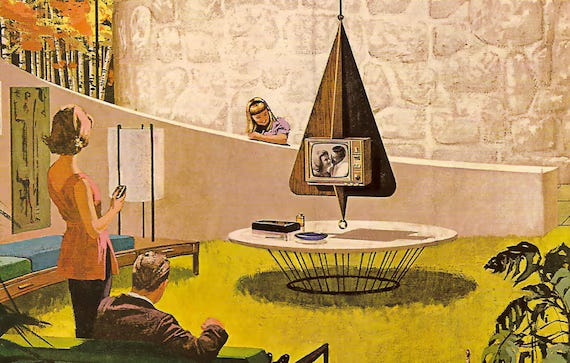
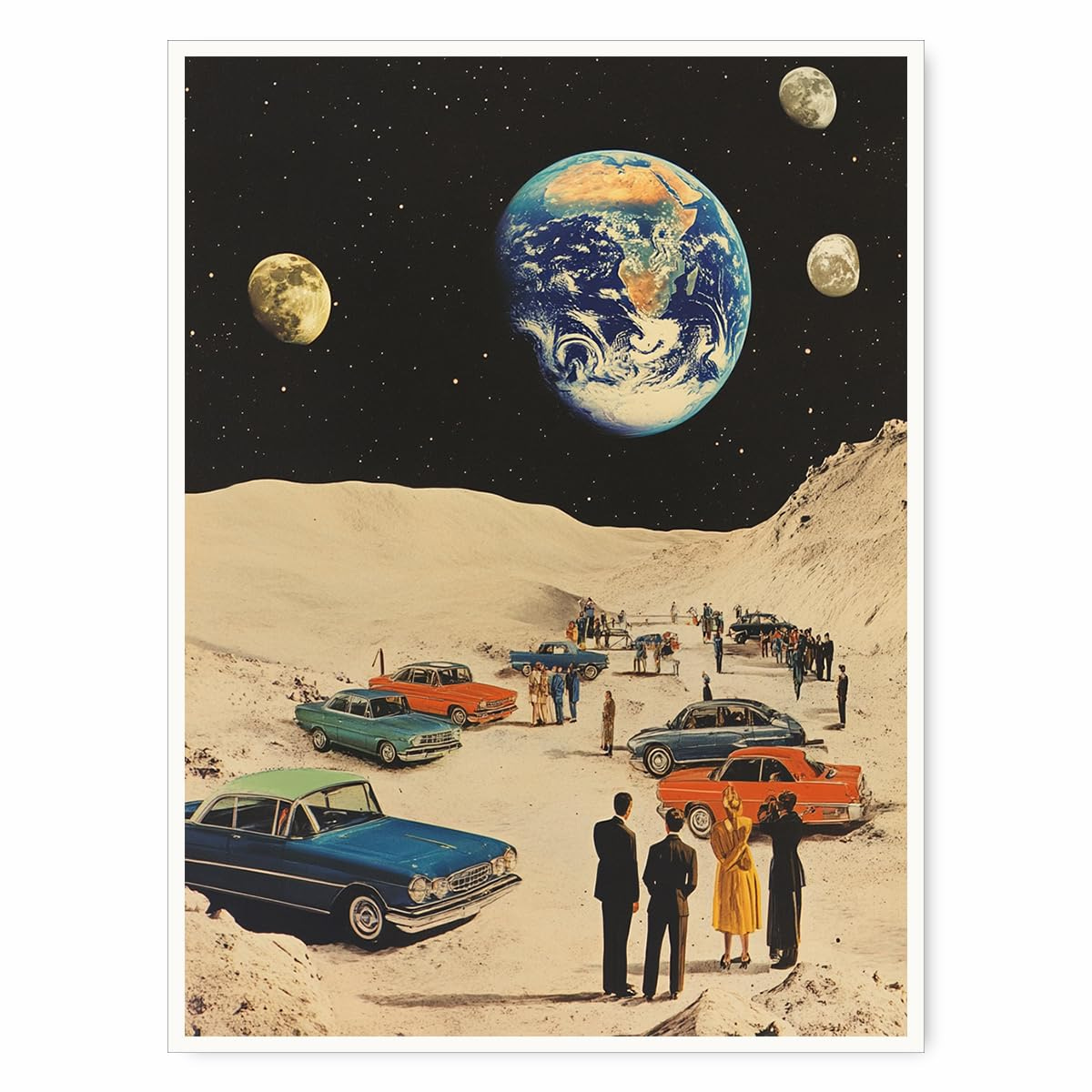
J.G. Ballard once wrote that we misunderstand the future because we misread its present. And he had a point. Look at the retro-futuristic posters of the 50s and 60s. Everything gleams with possibility: flying cars, self-driving cities, robot assistants clearing our calendars while we sip matcha in some frictionless Eden. Everything hovers or sparkles. But the people inside those futures?
They never change. The husband still walks through the door in his tidy suit. The wife is still smiling in the kitchen. The children are still obedient, scrubbed clean, nuclear-perfect. It’s astonishing, really: we imagined the sky transformed, but not ourselves. The future is just more like the present with shining tools. We built moon colonies, but couldn’t imagine a woman leaving the house.
And to be honest, for most of human history we’ve outsourced our imagination. Someone else … an engineer, a billionaire, a government would deliver the future to us, wrapped like a product launch. All we had to do was wait for a future where everything changed, except us.
The History of Borrowed Futures
For centuries, the horizon was small. If you were born in a village, the fields your grandfather plowed were the fields you would plow. Life ran on cycles: seasons, harvests, rituals. The world moved slowly enough for the mind to absorb it.
Then the industrial revolution widened everything.
Steam engines shrieked through cities. Railways compressed continents. Factories multiplied production. The future became a project designed not by communities, but by states, corporations, scientists, and capital. We accepted this. The world had grown too large for any one person to coordinate, so imagination scaled upward.
By the 20th century, the future became a product, pre-packaged and sold to a new consumer class. Television flickered in living rooms. Jet-age optimism soared. Silicon Valley garages glowed. Corporations began selling tomorrow the way they sold appliances: flying cars, nuclear kitchens, glass cities, humanoid robots, VR sanctuaries.
For a while, we trusted the people who promised these futures. Institutions felt stable. Progress felt predictable. Experts appeared certain. We outsourced imagination the way we outsourced manufacturing: efficient, centralized, handled by the people who “knew.”
And then, quietly, the logic broke.
COVID was the first moment many of us felt it: systems wobbling, explanations arriving late or wrong, the realization that the world no longer behaved according to the rules we were raised with. After that, it was hard to not see what was happening. Feeds updated faster than we could think. Truths dissolved by noon. AI began learning in the background. Geopolitical shocks rippled across continents before leaders could speak.
The future was no longer engineered in distant rooms. It arrived everywhere at once … chaotic, emergent, uneven. And the habit of outsourcing imagination collapsed with it.
Not because institutions failed (though they did).
Not because billionaires lost credibility (though they did).
But because the world became too fast and too entangled for imagination to remain centralized at all.
What We Got Wrong About The Future
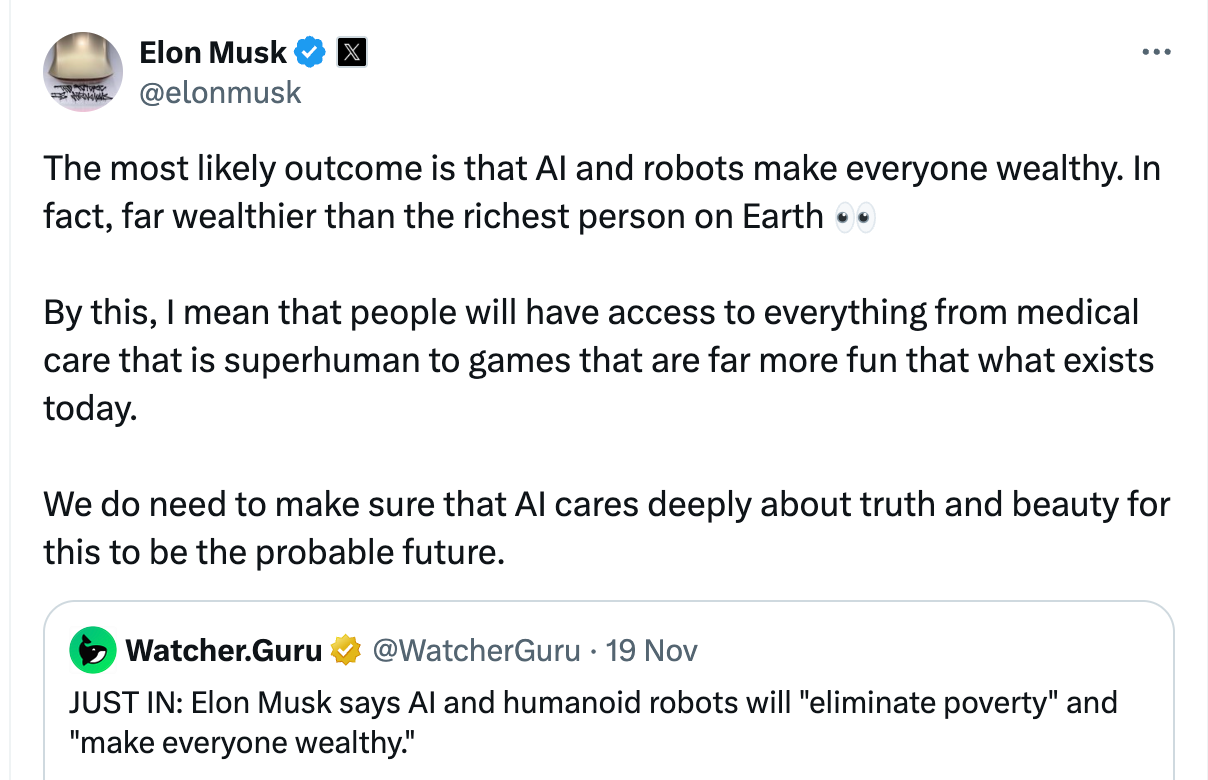
I’m not denying that the future might include robots serving cocktails by the pool. Fine, let them. What I resist is the way billionaires describe their preferred future as if it were the future.
The confidence. The inevitability.
The assumption that abundance will automatically produce meaning. As if our roles would stay frozen while the tools around us updated. As if making work free would dissolve the tensions that shape everyday life: what gets us out of bed, what holds families together, what gives work purpose.
“Don’t worry,” they say. “Everyone will be wealthy.”
And the room nods.
But we’ve heard this story before. Technology is not a destiny in itself. Systems decide who benefits. AI makes this even clearer. It doesn’t just accelerate information, it collapses time. Creation becomes instant. Knowledge becomes liquid.
For the first time in history, no one … not governments, corporations, or elites can reliably imagine the future for the rest of us. Not because they aren’t smart enough, but because the system itself has become ungraspable. The old modelof someone else will imagine the future, and we will step into it, is over.
What we are living through is a transfer of responsibility, from passive imagination to active participation.
What We Must Become
The old world is fading, not in cinematic collapse, but in a quiet erosion of the structures that once told us who we were: expertise, authority, certainty, the myth of the singular visionary. AI swallowed that version of us. It was obvious. The machine carries our tidy answers now.
So the question becomes: Who must we become in a world that no longer rewards prediction or control?
The next era won’t demand speed, or perfection, or limitless knowledge. It will demand human capacities that cannot be fully automated.
1. Seeing the World as a Living Ecology
In the industrial era, we could afford to live inside silos. A “career” meant selecting a vertical and mastering it. Reality was slow enough that a narrow view still yielded truth. But in the post-AI world, nothing lives alone anymore.
Economics bleeds into geopolitics. Technology rewrites intimacy. Climate reshapes identity. Culture shifts before language can catch up. The survival skill is no longer expertise. It is ecological perception: the ability to feel the tremor before the earthquake. To sense a cultural shift before the headline. To recognize emotional weather in a room and adjusting your tone.
This is the ability to perceive what has no name yet. Systems sense-making is the art of perceiving what has no name yet. This is a deeper kind of attunement.
2. Coherence as Survival
When the world moves faster than the mind can process, intellect becomes bodily. Attention becomes scarce. Emotions become manipulable. Updates outpace narration. The only stable ground is inside the nervous system.
The future belongs to those who can:
slow their internal tempo,
stay steady as information overwhelms,
tolerate ambiguity without grasping for certainty,
recognize a fear response before mistaking it for truth.
Think of a firefighter entering a burning building, their calm regulates the entire team. This is where we’re heading. Nervous system regulation becomes intelligence.
3. Judgment : The Last Human Frontier
For decades, we outsourced judgment to data, leaders, processes, best practices … anything that could reassure us: “Don’t worry, we’ve already thought this through”.
But AI now carries every answer we once treated as expertise. It drafts strategy, outlines vision, produces plans, faster and tidier than any committee. So something surprising becomes valuable again: point of view.
In a world of infinite information and instant creation, direction becomes the rarest human act:
context
discernment
taste
integrity
the courage to say this matters and this does not.
This is leadership in the post-AI world. Not a ladder-climbing or agenda-pleasing, but anchoring. If you don’t take a position, the chaos will take it for you.
The old world could be modeled
The new world must be felt
The future will show up quietly: in a choice in a meeting, a refusal to numb out, a willingness to pay attention even when reality is confusing, a decision made from integrity rather than fear or pleasing.
And we will create it the way humans always have: like walking through a dark forest … together, listening, attuned to what shifts in the air, taking the next step even when the path is not yet visible.
Don’t get me wrong: the future will be extraordinary.
Just not the one we were once sold in the past. Not the one painted in glossy posters or billionaire keynotes.
It will be stranger, more human, more alive than that because this time, we won’t wait for the future.
We participate in it.
Note about the author:
The Human Playbook is authored by Gil Almeida, a technologist who helped build some of the most influential platforms of the past decade. Working alongside founders and researchers in AI, she came to see that the real challenge of the coming era will be the preservation of meaning, memory, and the fragile human connections that hold our society together.
She is now joining a small group of builders challenging the dominant tech narrative through Sumbios, a project exploring relational intelligence: how we make sense together, how we stay human together, and how we create a future in which technology expands our capacity to connect.


So beautiful 🚀🙌
Reading this gave me a sense of peace, as if I could see through the blur